Tag: Energy Democracy

  • We can do better than SDG&E

    We can do better than SDG&E

    DSA San Diego has endorsed Power San Diego, a ballot measure to move the City of San Diego to its own municipal electric utility.

    The measure is currently gathering signatures to qualify for the November 2024 ballot. DSA members are helping gather signatures, including at some of the events you can find on the Power San Diego Events Calendar. The signature gathering has a deadline of May 7th, so sign as soon as you can!

    You can also request a mail-in petition.

    Find out more about the work our chapter is doing on Energy Democracy.

  • To San Diego City Council re: 5/25 Franchise Agreement Vote

    Sent by email to each member 5/23

    To the president, president pro tem, and members of the San Diego City Council,

    On Tuesday, May 25, you will cast your votes on the proposed energy and gas franchise agreements with SDG&E, shepherded by Mayor Todd Gloria. As we have requested in communications across multiple media and as you’ve heard from hundreds of our members, the Democratic Socialists of America San Diego chapter urges you to vote no. Those of you who have already committed to vote against the agreement – we respect and appreciate your conviction. To those who are not yet decided, we urge you to consider the inescapable contradictions posed by signing a 10-20 year binding agreement with an investor-owned utility staked in the long-term combustion of fossil fuels.

    There has been a lot of discussion during this renewal process about the future of workers, as well there should be. No matter who owns and manages our utility infrastructure, workers on the lines and building upgraded systems are vital to assuring strong energy service we can rely on, day after day. Yet we are accelerating into a future that will render untenable a business model like Sempra Energy’s, anchored as it is on combusting the liquid natural gas it stores and transports northward from Baja California. Theirs won’t be an orderly, stable transition. If the fate of the coal industry is any predictor, our utility is likely to be sold off as its distressed corporate parent salvages parts, leaving workers in the lurch. If the distress reaches the point of bankruptcy, workers may well be the first parties to be left high and dry — paychecks and pensions in question.

    There has also been a lot of discussion during the renewal process about SDG&E’s sky-high rates. Members of our chapter have talked extensively to our neighbors in Barrio Logan and Rancho Bernardo, and have gathered tenants and workers together in community forums. There is no scenario featuring SDG&E as the franchisee that rates will become lower, lessening the burden on already burdened households. Members of underserved communities in San Diego are squeezed by the forces of gentrification and low wages — high energy rates put them at risk of service shutdowns that will become increasingly deadly as global warming continues.

    Please stop kicking the can down the road. Vote no for another franchise agreement with SDG&E and immediately begin the process of transitioning to publicly owned and operated power, serviced by workers with accountable union representation and a contract worthy of their contributions.

    Sincerely,

    DSA San Diego

    Energy Democracy Campaign

  • Tell City Council to vote NO on 20 more years of fossil fuel control of our energy grid!

    The Mayor’s office is pushing forward a plan that would mean 20 more years of SDG&E – a subsidiary of Sempra Energy, a multinational fossil fuel conglomerate – as the utility with exclusive rights to provide San Diego’s electric and gas services.

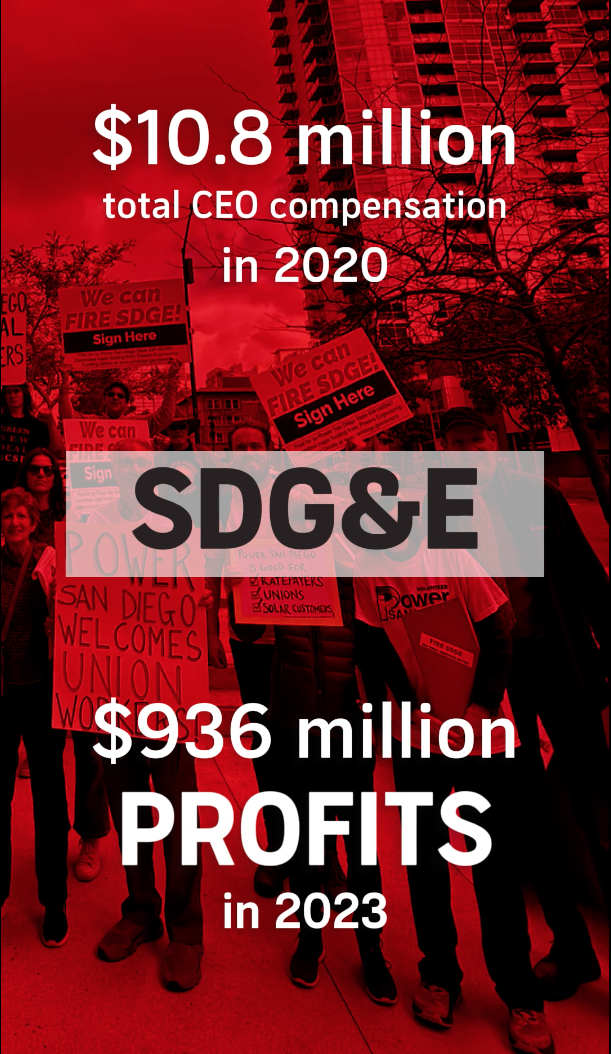
    Under SDG&E, San Diegans pay the highest rates for electricity in the continental US, while SDG&E rakes in hundreds of millions in profit per year. With SDG&E as our utility, there is no chance of San Diego taking the decisive action required to prevent the worst effects of climate change.

    Thankfully, City Council can put a stop to this deal. This is where you come in – we need YOU to send a message to your council member, demanding they vote NO on this new deal!

    Fill out the form below to send a message to your council member.

    If you would prefer to call your council member, you can find your City Council district and contact information using this interactive map.

    Below is an example of a call script you could use when contacting your council member:

    Hi my name is ____, and I’m a constituent of District ____ calling to urge Councilmember _____ to vote NO on Mayor Gloria’s new deal with SDG&E. For decades SDG&E shareholders and executives have profited at the expense of San Diego ratepayers. It is unjust for San Diegans to be forced to pay the highest rates in the continental United States, while Sempra profits more than $1,000,000 each day. We should not have to pay twice as much as Sacramento and 50% more than Los Angeles. You have the opportunity to reject profits being pulled from our pockets by an unaccountable corporation. Please fight for your constituents and reject Mayor Gloria’s flawed agreement. Thank you.

    You can find more background information on our main campaign page: https://dsasandiego.org/energy-democracy

  • Tell City Council: San Diego Deserves a Public Energy Utility

    The City of San Diego’s 50-year franchise agreement with SDG&E for electric and gas services  is set to expire in June. This is a once-in-a-century opportunity to change the direction of San Diego’s energy future, to turn away from a private company owned by a fossil fuel conglomerate, towards a publicly owned and operated utility responsive to the people’s demands for lower utility bills, climate justice, and clean energy.

    We don’t want a new franchise agreement with any private company – so we need our City Council members to vote NO on any bids, and to start working on establishing a public energy utility immediately!

    For more information on how to take action, visit https://dsasandiego.org/energy-democracy

  • Call in for Public Power: Thursday, Dec 17, 10 am

    This Thursday, December 17 at 10 am newly elected Council President Jennifer Campbell has called a special meeting to open the electricity and gas franchise agreement bids that her predecessor refused to docket due to a deeply flawed process. We encourage all members and supporters of our public power fight to please call in to offer your public comment.

    Phone in Testimony
    After the meeting begins at 10 am, when the Clerk introduces either the item you would like to comment on or the comment period for, Non-Agenda Public Comment or Closed Session Public Comment, follow the instructions within the  “Public Comment Instructions” by dialing the number below to be placed in the queue.

    1. DIAL 619-541-6310
    2. Enter the Access Code: 877861 then press ‘#’.

    Proposed talking points – personalize for greater effect:

    1. The last council president refused to docket the opening of these bids for good reason. The process for developing the invitation to bid and determining the city’s best course of action was extremely flawed, with members of the community given almost no time to absorb and respond to the report prepared by the city-contracted consultants. The advisory body focused on sustainable energy could not meet quorum most of the year given the last mayor’s failure to fill vacancies, and ergo never discussed or provided their advice to council on the merits of the consultant’s report, recommendations, and potential opportunities.
    2. It is clear that in an economic crisis where thousands of San Diegans are experiencing heightened instability that the best path forward for utility service most just and equitable to members of our community is the path away from corporations who extract the City’s franchise fee from our pockets and build their own profits into the revenue model. The City should not be balancing its budget on the backs of the working class.
    3. We urge members of City Council to position any next steps within the context of a binding commitment to public operation of our electricity and gas utilities. Interest rates are at an historic low, there is no better time to begin this transition.
  • City Council Environment Committee public comment guide

    Thursday, July 16, 2020, San Diego City Council’s Environment Committee will hold a public comment meeting regarding San Diego’s energy franchise agreement with utility grid operators. Below you can find background information and recommended comments for the event:

    City Council, Environment Committee meeting

    Thursday, July 16th at 1 pm

    Agenda

    Viewing/dial-in instructions below

    Public Comment Instructions

    • View: To watch the meetings, go to this link and click “Watch CityTV Live Feed” on the right hand side of the page
    • Dial-in: Public comment instructions (from the city)
    • 1. Wait for the Clerk to introduce the item you wish to speak on and open the Public Comment line, then call in by following the steps below.
    • 2. DIAL 619-541-6310 and enter the Access Code: 877861 then press ‘#’.
    • 3. You will then hear “you are now being placed into the conference. You are now muted.’
    • You will be able to hear the proceedings through the phone line and WAIT for your turn to speak.
    • 4. You will hear a system prompt stating “Your phone has been unmuted” THIS IS YOUR OPPORTUNITY TO PROVIDE YOUR PUBLIC COMMENT (This is not a question-and-answer period, this is your time to provide a statement.)
    • 5. When prompted by the Clerk, please state your name for the record and what item your comment is for.
    • 6. You will have the allotted time given by the Chair to provide your comments. Once your time has ended, you will be moved out of the queue and the call will be ended.
    • 7. Participants who wish to speak on other items on the Agenda or for other comment periods please call back when the Clerk introduces those items or comment periods to be placed back in the queue. Please monitor the meeting via City TV OR ONLINE and not through the phoneline.
    • Written Comment: Prior written public comment instructions
    • If you’re not able to call in to either meeting, you can submit a written comment prior to the meeting
    • “Comments received by 1:45 p.m. will be distributed to the Committee and posted online with the meeting materials. All webform comments are limited to 200 words. Comments received after 1:45 p.m. the day of the meeting but before the item is called will be submitted into the written record for the relevant item.”
    • Here’s the form to fill out
    • You will need to specify whether you’re commenting on a non-agenda item or an agenda item
    • If it’s the latter, you’ll need to supply the agenda item number

    Talking point suggestions

    General suggestions

    • [Start here] I am in favor of pursuing municipalization, and I feel that the City’s consultants did not adequately explore pathways to public ownership. City Council needs an in-depth analysis of its options in order to make an informed decision.
    • If the City Council is unwilling to pursue that strategy, the terms of the next franchise agreement must be much stronger. I am not satisfied with the recommended terms that the mayor’s office has put forward.
    • [Pick some of the below] 
    • A 20-year term is far too long of a monopoly to grant given the rapidly changing energy environment; we need a 5-year agreement
    • Given SDG&E’s disregard for the terms of the current franchise, the next agreement needs strong mechanisms for accountability that directly impact the utility’s shareholders; it should levy daily penalties on shareholders for violation of the agreement’s terms.
    • The agreement must mandate that the utility work with the City to achieve the goals of its climate action plan.
    • Provisions should be included that require local investments in renewable energy that benefit the local workforce.
    • It should also guarantee all those employed by the utility a living wage, benefits, and the right to unionize.

    More detailed arguments

    • Public ownership means San Diego keeps the money that would otherwise go to a utility and its shareholders
    • As has been made especially clear by COVID-19, the City needs revenue to fund vital services
    • By signing another franchise agreement, the City is forfeiting ratepayer dollars and allowing them to be the profit of an investor owned utility
    • If the City created a municipal utility, the proceeds from ratepayers would accrue to the City itself
    • These funds could then be used to properly maintain energy infrastructure, fund local economic development, support the initiatives of the climate action plan, or boost public services
    • Public ownership means operating the vital public utility of energy for the public benefit, not to enrich investors
    • Investor-owned utilities have a duty to their shareholders to maximize profits
    • They seek to generate as much profit as possible, given the constraints of California Public Utilities Commission regulations and the terms of their franchise agreements with various municipalities
    • And as SDG&E has shown, it’s not afraid to violate the terms of its franchise agreement if it thinks it can get away with it
    • This is why SDG&E has been a bad partner for the City – like all investor-owned utilities, it operates in the interest of investors by design
    • Let’s reject that ownership model and instead design a public utility that operates in the public interest
    • The MRW and Associates report on the feasibility of municipal acquisition of gas and electric assets finds a very high likelihood of substantially lower costs with a public utility than with SDG&E
    • They find that ratepayers would pay less with a public utility than with SDG&E in all but a low probability, high-cost scenario for electricity and that they would pay lower rates in all scenarios for gas
    • The report says quote ”It is important to note that the High- and Low Cost scenarios are extreme: it is very unlikely that all the key variables will align either positively or negatively.”
    • It also notes that quote: “readers should view the results and conclusions of this report as draft and preliminary.”
    • Given that this preliminary assessment suggests significantly lower costs to ratepayers with a public utility, the City Council has a responsibility to its constituents to commission a thorough, final analysis before making any further decisions regarding San Diego’s energy future

    Quotes from the reports favorable to municipalization

    • “Typically, community-owned utilities provide service at lower rates than investor-owned utilities.”[1]
    • “The NewGen/Advisian/MRW team concluded that in the “Base Case” (the most probable of the various scenarios examined) the City-owned electric distribution utility is economically feasible.”[2]
    • “They also concluded that in the “Base Case” the City-owned gas distribution utility would be economically feasible.”[3]
    • “The electric distribution utility…would obtain control of about $121 million per year in State-mandated electric public purpose program which it could deploy for projects directly benefiting City residents and businesses.”[4]
    • “In addition, the City would obtain control of approximately $17 million per year in natural gas public purpose program charges which it could deploy for projects directly benefiting City residents and businesses.”[5]
    • “[F]ocusing solely on community-owned utilities, they typically provide service at lower rates than investor-owned utilities.”[6]
    • “Typically, municipal energy enterprises:
    • Provide local control to pursue local policy objectives such as economic development or renewable energy development
    • Have rates lower than investor-owned utilities
    • Achieve high levels of customer satisfaction”[7]

    Background Resources

    Documents

    Information On (some of) SDG&E’s Antagonistic Behavior

    • The City of San Diego has asked SDG&E to relocate infrastructure so that it can build a water recycling plant, SDG&E has refused
    • The City is currently suing SDG&E for the $36M it has had to pay the utility to move its infrastructure, despite clear language in the franchise agreement that states the cost burden should fall on SDG&E
    • Historically, undergrounding projects at SDG&E cost about $4.5 million per mile.
    • But some of the work has exceeded $10 million per mile, with other sections “potentially approaching $20 million per mile, without sufficient documentation to justify such increases.”
    • The current agreement, for example, required SDG&E to pay the city 3 percent of the gross revenue it earned from electricity and natural gas sales to residents. Yet SDG&E was successful in the 1970s in getting the California Public Utilities Commission to let it collect the franchise fee directly from customers and pass it through to the city.
    • This sleight-of-hand has cost residents at least $1 billion to date.
    • San Diego Gas & Electric has asked the California Public Utilities Commission to allow the power company to institute a fixed charge on monthly bills. It also wants to nearly quadruple the bare-bones minimum it charges customers each month.
    • Opponents say it amounts to a one-two punch that will penalize customers who don’t use that much electricity and will especially hurt those who have installed — or are considering — rooftop solar.
    • After publicly lobbying on CCA last week before the county Board of Supervisors, officials with the SDG&E marketing arm, Sempra Services Corporation, said they’ve been meeting with lawmakers countywide on this issue since September. Those include San Diego Mayor Kevin Faulconer and several council members.
    • This lobbying caught the attention of the commission’s regulators, who said this week that SDG&E’s marketing division has never received approval to lobby on CCA. They also said they’re looking into the lobbying and that violations could be subject to fines as high as $50,000 for each offense.
    • Direct CPUC intervention and pressure on SDG&E to purchase the (overly costly and unnecessary) Otay Mesa plant, conditioning its request to purchase the Palomar plant on the Otay Mesa purchase
    • Done in an effort to provide much-needed capital to an energy company struggling in the wake of the energy crisis fueled by the manipulation of deregulated energy markets by Enron, energy generators, and energy utilities
    • Utilities make money when they build power plants and transmission lines
    • Witch, Guejito and Rice fires caused by improperly maintained SDG&E equipment resulted in $379M in damages that utility has tried to pass on to consumers through increased rates
    • The 4th District Appellate Court and California Supreme Court have rejected SDG&E’s request


    [1] JVJ, “Report to the City of San Diego Concerning Electric and Gas Distribution Systems” , page 5

    [2] JVJ, page 6

    [3] JVJ, page 7

    [4] JVJ, pages 6-7

    [5] JVJ, page 7

    [6] JVJ page 13

    [7] JVJ page 48

  • Demanding Better Accountability for San Diego’s Energy Future

    DSA San Diego’s Energy Democracy Campaign Committee sent the below letter to the San Diego City Council and city attorney on Sunday, July 12th, 2020.

    Dear Council President Gomez and members of San Diego City Council,

    As the coordinating committee of DSA San Diego’s Energy Democracy campaign, we write with great frustration over the unfolding process for the City to ratify a new franchise agreement for operation of the City of San Diego’s energy utility(ies). It is unclear how thoroughly each council member has been briefed on the process, as the Environment Committee has not convened since the last official milestone, publication of expressions of interest in utility operation. At that time, DSA San Diego submitted a letter describing our strong preference for democratic, public ownership of San Diego’s utility service.

    Unfortunately, responses to the Request for Expressions of Interest (RFEI) were never discussed by the Sustainable Energy Advisory Board (SEAB), as the board has not met quorum since March 12. That last meeting took place approximately three weeks after the RFEI deadline of February 21, yet none of the letters were made available to the public or board to inform discussion. The terms and options for utility provision strike us as among the most important topics warranting the attention of such a board, and yet it has been left largely in the dark. While failing to meet quorum may seem coincidental, the high number of vacancies on the board and inscrutable delays in finalizing appointments certainly do not.

    By all appearances, City Council has not been engaged in deliberations over the terms of the franchise agreement until on July 9 the Mayor’s office submitted the report with recommendations for the Invitation to Bid (ITB) prepared by consultants whose professional grounding lies squarely with investor-owned utilities. A special meeting of the Environment Committee was announced within the day. While we appreciate that after several months we will have the opportunity to encourage comments from our members, it seems to be too little, too late.

    The committee has received no input from the SEAB on options, nor has the committee heard the public’s hopes and desires for our utility service. The report itself incongruously mentions the popularity and significant advantages of municipalization, then dismisses municipalization as an option for San Diego due to a California Public Utilities Commission (CPUC) statute prohibiting Community Choice Aggregation (CCA) in areas serviced by a municipal utility. Missing is any consideration of an option to expand the mission of our not-for-profit CCA San Diego Community Power to include the publicly accountable management of power distribution alongside power procurement.

    And while we understand concerns about municipalization due to the legal definition of the powers wielded by community choice aggregators — namely, that SDCP cannot take on powers beyond the procurement of energy — we were disappointed to see that the JVJ report merely acknowledged this concern without providing any analysis on potential remedies or precedents. San Francisco, which also has a CCA called CleanPowerSF, recently conducted a study on the feasibility of municipalization and decided to move forward with a bid to purchase their energy infrastructure from PG&E. While PG&E rejected their initial offer, the point remains that presence of CCA does not necessarily preclude the possibility of municipalization. The fact that San Diego City Council members do not have a report that thoroughly maps a pathway to municipalization means that they are not able to properly assess the costs and benefits of that approach.

    Representing this priority for our chapter, the DSA San Diego Energy Democracy coordinating committee calls on City Council to pause this process until the full range of options has been rigorously explored and deliberated on in good faith. We find it outrageous that Mayor Faulconer expects ratification of an agreement explicitly designed to offer a corporate operator a 20-year monopoly on San Diego’s energy service, and feel skeptical that provisions for accountability will be honored, as we’ve seen SDG&E so flagrantly flaunt the terms of their original 1970 agreement so frequently over the years.

    Please exercise your authority and leadership in this critically important process. The franchise agreement requires a two-thirds majority to pass, so it is certainly within your power to insist on better analysis, better understanding, and a better structure for the people of San Diego.

    Sincerely,

    Energy Democracy Coordinating Committee
    Democratic Socialists of America – San Diego

  • Energy Democracy Campaign Update

    In May, our Energy Democracy campaign was designated a priority campaign by the chapter. The timing couldn’t be better. Energy Democracy is a movement across the country to convert privately owned energy utilities into public management and ownership, and to bring greater transparency and accountability to municipal utilities and rural energy cooperatives. The need to transition to renewables is too urgent to let corporate shareholders and fossil fuel lobbyists call the shots – public power is a public good, essential for climate justice.

    SDG&E is owned by Sempra Energy, whose primary business is storing and shipping fracked natural gas. Sempra operates massive operations in Ensenada and Louisiana, and is building a new terminal on Texas’ gulf coast. Our Energy Democracy campaign offers the opportunity for solidarity with chapters across the continent and transnationally, as we fight to shut down global circuits of extraction and existentially dangerous carbon dioxide emissions.

    This week, the City of San Diego will begin considering terms for a new energy franchise agreement. The current 50-year agreement with SDG&E will expire on January 20, 2021, and two other bidders have stepped forward to compete. City Council’s Environment Committee will meet on July 2 at 1 pm, and will begin discussion of terms for the new franchise agreement. UPDATE: This meeting has been postponed by the city council, and they have not provided a new date yet.

    We urge DSA members and friends to offer public comment during this meeting to let members of the Environment Committee know that public accountability is crucial for achieving a transition to renewable energy that doesn’t put the financial burden on the working class. (This post will be updated with dial-in details as soon as they’re available.)

    Many more activities are being planned for this crunch time for our campaign, so please reach out to sandiegodsa@gmail.com or (members only) join the #wg-met-ecosocialism channel on Slack to find out more.

  • DSA San Diego Calls for a Publicly Owned Gas and Electric Utility in San Diego

    This week, DSA San Diego submitted the below letter to the City of San Diego in response to their Request for Expressions of Interest in the city’s Franchise for Electric and Gas Services, calling for a publicly owned utility for gas and electric services in San Diego.

    This letter was submitted as a part of DSA San Diego’s campaign for energy democracy in San Diego County.

    Re: Request for Expressions of Interest for Gas & Electric Services (1/21/20)

    Dear Mr. Lee Friedman, Mayor Kevin Faulconer, Council President Gomez, and Members of the San Diego City Council,

    While most Americans receive power from private companies, most utility companies in the United States are publicly owned. The largest is the Los Angeles Department of Water & Power. Almost all utilities were municipal services until World War I, when private companies took over urban electricity systems. This left rural areas dark until FDR’s Rural Electrification Act of 1936 built the remaining infrastructure. We propose a utility company for San Diego that is neither unique nor uncommon. In the words of former California Public Utilities Commission president Loretta Lynch, “Public power is generally cheaper, safer, cleaner, and – with some exceptions – more reliable.”

    Public Power for San Diego is a project of Democratic Socialists of America (DSA) – San Diego. DSA San Diego (https://dsasandiego.org) is a volunteer-led political activist organization. It is a chapter of DSA, the largest socialist group in the United States and a registered 501(c)4. In the current effort, we align with Boston’s Take Back the Grid (http://www.takebackthegrid.org/) and the San Francisco Bay Area DSA campaign, Let’s Own the Grid (https://letsownpge.org/) in encouraging our neighbors and the representatives who serve them to reclaim our energy system as a public good — run democratically, with all benefits accruing to our community.

    The RFEI invites the public to “help the City and its expert consultants draft and develop a contemporary and attractive franchise that will secure additional benefits…” First among these benefits, we submit, should be public ownership as a public good. Second should be management of the utility in a democratic fashion. Third should be an investment strategy which dedicates surplus revenue to local purposes, such as building out decentralized, renewable energy sources and storage, and introducing solar and retrofitting clean energy infrastructure to communities of concern — all while preserving the existing benefits, standing, and rights of the unionized workforce.

    We propose a publicly owned utility which protects the people and environment of San Diego without the existential need for profit that drives an investor-owned corporation. We propose a utility which invests revenue in its employees and in meeting the 2035 clean energy goal set by the
    City Council. We have the only proposal which serves the people of San Diego first, and we look forward to presenting it to you and our neighbors.

    Thank you for your attention.